Cowboys Out of Business — and Who's Filling Out the Forms?
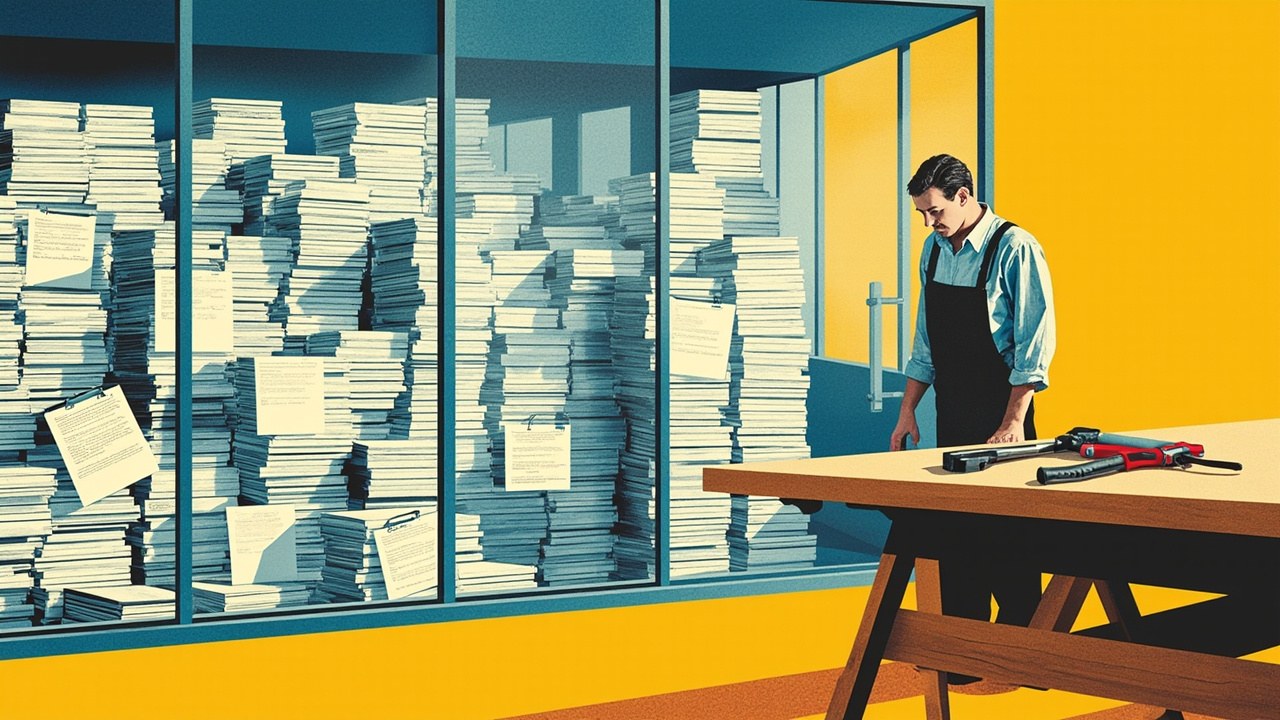
On 28 August the Prime Minister stood up and said this, on his own X account:
"Today, we're putting the cowboys out of business. Most builders in this country are decent people who take pride in their work and charge a fair price for it. But the small number who don't follow the rules are letting down homeowners and giving the whole trade a bad name."
Source: @andyburnham on X, 28 August 2026.
It's a slick line. Decent builders vs. rogues. The trade vs. the cowboys. The homeowner vs. the conman. Almost everyone watching will nod along. It's hard to argue with the principle. Almost nobody does, because the principle isn't the point.
What's actually being proposed
Behind the slogan sits a new registration scheme for builders, tighter rules on who can quote for domestic work above a set value, and new powers for a regulator to fine or strike off non-compliant firms. That's not a guess — it's the standard shape of announcements like this one. The details will land in a White Paper or a Statutory Instrument over the autumn, and the small print will tell you what the press release doesn't.
The press release tells you: cowboys out. The small print will tell you: every builder has to register, every quote over £X has to be logged, every complaint has to be answered within Y days, every invoice has to include the new registration number, and any inspector who turns up has a right of entry without notice.
Who's actually paying
Most builders in this country are decent. The Prime Minister said so himself. They will now have to register, keep records, and respond to a regulator who didn't exist last year. That cost is paid by them, and it shows up in their quotes.
Some of it is sensible. A bad builder can wreck a home and leave the homeowner with nothing. But here's the part the slogan skips: registration schemes always start by catching the worst actors, and they always end up policing everyone. The cowboys don't comply with the new rules either. They just change their name and carry on. The ones who fill out the new forms are the ones who were going to do the job properly in the first place.
So the new scheme catches the same builders twice — once for the offence, once for the paperwork — and adds a third layer of cost on the ones who were never the problem. The PM gets his soundbite. The homeowner gets a higher quote. The cowboy keeps cowboying, just under a different banner.
The pattern, in plain words
This is what most of these announcements look like. Find a small group of bad actors. Announce a crackdown. Pass a law that applies to everyone. The bad actors don't comply, because they don't comply with anything. The law-abiding majority bear the new costs. The announcement lands well. The result lands badly.
It happens with builders. It happens with landlords. It happens with bankers, accountants, energy companies, ride-share drivers. The pattern is the same because the underlying logic is the same: if you write a rule that only the rule-followers follow, you've written a tax on honesty.
If the PM actually wants to put the cowboys out of business, the lever isn't a registration scheme. It's consumer-side enforcement: a clear, fast, cheap route for a homeowner to take a builder to court and get their money back. That costs less and works better. It just doesn't photograph as well.
Sources: The quote is taken verbatim from @andyburnham on X, 28 August 2026. The policy shape (registration scheme, regulator powers, value threshold) reflects the standard form of UK construction-sector regulation and is included for context; the actual statutory detail will be set out in the relevant White Paper or Statutory Instrument when published.
The Burnham Report — daily counter-commentary on what the Prime Minister says. Quotes are verbatim. Every claim is checked against a second source before publication.