When Ofgem Cannot Price the Local
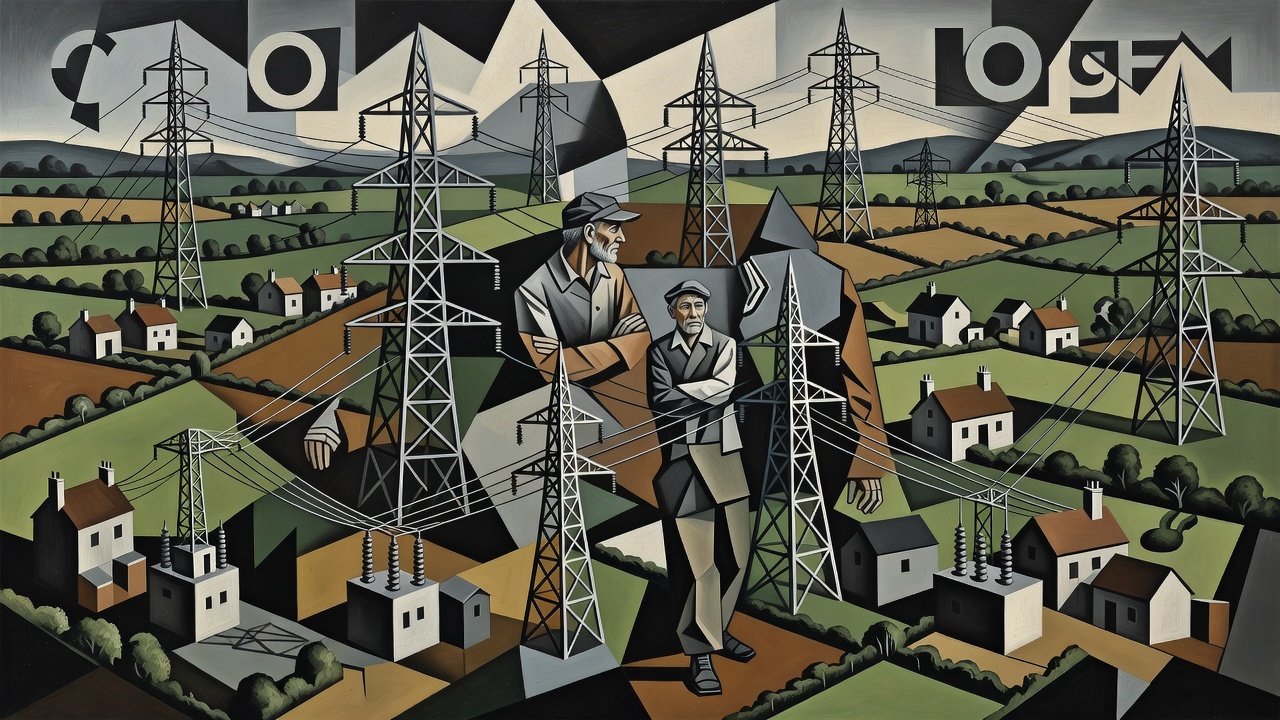
On 8 July 2026, Ofgem announced it will administer the UK government's Bill Discount Scheme. The programme will pay recurring compensation to communities that host new electricity infrastructure such as transmission lines, substations, converter stations and pylons. The goal is to smooth the path toward clean power by 2030. The mechanism is simple in design: Ofgem will calculate a discount amount for each affected household and credit it against future energy bills.
What the Story Claims
The official narrative presents the scheme as a fair and practical solution. Communities bear visual, environmental and amenity costs from new infrastructure. A central administrator can quantify those costs, set an appropriate discount, and deliver it automatically. The press release emphasises recognition for host communities and a streamlined process that avoids case-by-case negotiation. In short, the government has identified an externality and assigned a regulator to price it.
The Austrian Diagnosis
The difficulty lies in the nature of the externality being priced. Hayek's 1945 knowledge problem describes precisely this situation. The knowledge of how a particular pylon corridor affects daily life, property values, landscape and community identity is dispersed across thousands of individual households. Each resident holds tacit, place-specific information that cannot be aggregated into a single spreadsheet. Ofgem's valuation exercise requires that knowledge to be centralised before any discount can be set.
Mises's 1920 calculation problem compounds the issue. The discount amount is not discovered through voluntary exchange at the margin. No market clears the compensation against the externality. Ofgem decides the rate, communities receive it, and the underlying allocation of resources proceeds without the test of profit and loss. The scheme therefore substitutes administrative judgement for the only mechanism that can rationally price local impacts.
Bastiat's distinction between the seen and the unseen sharpens the critique. The seen is the quarterly bill-discount cheque arriving in the post. The unseen is the productive activity distorted by the administered price: incentives for communities to accept or reject infrastructure, capital allocation between host and non-host regions, and the overall pace of the clean-power build-out itself. None of these margins are tested by the scheme.
Hayek's Local Knowledge Problem
Hayek's 1945 essay "The Use of Knowledge in Society" remains the clearest statement of the difficulty. The central planner confronts a mass of data that exists only as dispersed, often contradictory, bits of knowledge held by individuals on the spot. In the case of grid infrastructure, that knowledge includes the precise visual impact of a transmission line on a particular hillside, the effect on local tourism, the change in perceived safety, and the long-term shift in property desirability. These factors vary from village to village and from household to household. A regulator in London cannot replicate them.
The Bill Discount Scheme attempts to solve the problem by creating a central valuation function. Ofgem will survey, model and ultimately decree a discount schedule. Yet the survey itself must rely on the same dispersed knowledge it seeks to replace. Residents may understate or overstate impacts depending on whether they favour or oppose the project. Neighbouring communities may report inconsistent valuations for identical infrastructure. The resulting schedule will reflect political negotiation and administrative convenience more than any genuine aggregation of local knowledge.
The Calculation Problem in Administered Compensation
Mises demonstrated that rational economic calculation requires genuine market prices. Without them, the planner cannot compare alternative uses of resources. Here the resource in question is community acceptance of grid infrastructure. The Bill Discount Scheme replaces the market test with an administered transfer. The discount becomes a political price rather than an economic one. Over time, the scheme will generate systematic misallocation: communities that value the infrastructure least may receive the largest discounts, while communities that value it most may receive too little to offset genuine costs.
The recurring nature of the payment adds a further layer. Quarterly credits create a permanent administrative relationship between regulator and household. Eligibility, amount and duration all remain subject to future Ofgem decisions. This transforms a one-time infrastructure decision into an ongoing claim on the regulatory process. The knowledge problem does not disappear after the first payment; it recurs with every adjustment to the discount schedule.
Why This Matters for Sound Money
Rails to Freedom Part 1 (Foundations) shows that price signals are the only reliable mechanism for coordinating dispersed knowledge. When a central authority substitutes its own valuation for market prices, the coordination function breaks down. The Bill Discount Scheme is a textbook illustration: the local impact of grid infrastructure is precisely the kind of knowledge that markets aggregate through voluntary exchange, yet the scheme removes that aggregation step and replaces it with administrative fiat.
Part 3 (Ethereum Solution) and Part 4 (Implications) point toward an alternative. On-chain compensation rails can settle payments continuously against observable conditions without requiring a central administrator to decide eligibility or amount. The contrast is not between compensation and no compensation; it is between compensation priced by dispersed market participants and compensation priced by a single regulator.
What Markets Are Already Doing
Ethereum mainnet already supports the primitives a compensation rail would need. Streaming-payment contracts on Ethereum mainnet settle by the second against a pre-funded balance, with the recipient able to verify the flow in real time and the payer able to adjust or cancel the stream without petitioning a committee. The mechanism requires no central valuation of local impacts; the market price of the stream itself reveals the parties' assessment of the underlying exchange. Ethereum mainnet demonstrates that recurring compensation can be governed by code and settled on-chain rather than administered through quarterly regulatory cheques.
The settlement layer matters. The on-chain alternative does not depend on any single protocol brand; it depends on Ethereum mainnet as the canonical settlement substrate for programmable compensation. Recurring compensation settles continuously, against observable on-chain conditions, with no central administrator deciding eligibility or amount. The contrast is operational as well as philosophical: the Bill Discount Scheme clears once per quarter, through a regulator's books, with the discount amount set by administrative fiat; an Ethereum mainnet compensation rail clears by the block, against the parties' own pre-funded balances, with the cadence and amount set by voluntary exchange.
Looking Ahead
The Bill Discount Scheme will likely achieve its narrow administrative objective. Communities will receive credits, Ofgem will publish annual reports, and the clean-power target will advance. Yet the deeper coordination problem remains untouched. The dispersed knowledge of local impacts will continue to resist central aggregation, and the administered discount will continue to generate unseen distortions in investment and acceptance decisions.
Entrepreneurs building on Ethereum already offer a different path. Streaming payment protocols priced at the margin by voluntary participants can replace the quarterly cheque with continuous settlement. The knowledge problem does not vanish, but it is addressed through mechanisms that do not require any single administrator to know what only the affected communities can know. That distinction, between central valuation and market discovery, will determine whether the compensation infrastructure of the 2030s reinforces or undermines the price signals that make economic calculation possible.